


……… continued from last post
The "first 256 ( 0, 1, 2 …… 255 )"
Ascii and perpetrating ANSI historical reference misnomers
7 (8) Bit Byte Ascii
So these ASCII numbers and character lists, got organised in the ways discussed above, and we end up describing ASCII as Single Byte (which is 8 Bits), encoding using the bottom 7 digits. That might mean, for example that the first digit Bit would be used for something else, but I have not heard of anything about that.
Having the eight digits, and so the possibility to go up to numbers of 128+127=255, can blur the issue a bit, and we may sometimes be talking of things like "extended ASCII" going up to at least 255. (Of course with 8 digits we can go from [0] to [128+127=255] ). But officially, Ascii is an internationally defined standard for the first 127. Any extensions are not ASCII**.
At about 1981, for example, IBM got seriously into a PC attempt, and introduced a "Code page 437 (IBM PC)", as most (not all) such things it takes the standard Ascii up to and including 127, then up to 255 had what was an attempt to make the best compromise to make the best chance of character encoding standardisation which suited at the time. There is no formal definition of "extended ASCII"**, and is often mistakenly interpreted to mean that the American National Standards Institute (ANSI) .
ANSI as applied to an 8-bit character encoding that includes the ASCII characters is not a thing, far less a standard. Microsoft are at least partially to blame for this common error (Microsoft's 8-bit character encoding for the latin character set is actually called Windows-1252 - or cp1252, since we have now moved into the world of Code Pages -, which doesn't really trip of the tongues as easily as ANSI). As they themselves say "The term ANSI as used to signify Windows code pages is a historical reference, but is nowadays a misnomer that continues to persist in the Windows community."
So when talking about ASCII, we blur into ANSI, which started somewhat later and tends to also have the Byte (so 8 Bits) as its "unit", but generally always does use all available 255 numbers in a Byte if it is used for basic text, mainly to allow extending into some of the main non English characters.
You should expect to get a bit confused with Bits and Bytes. Don’t worry too much. Hopefully re reading the first few posts in this page will help get it clear.
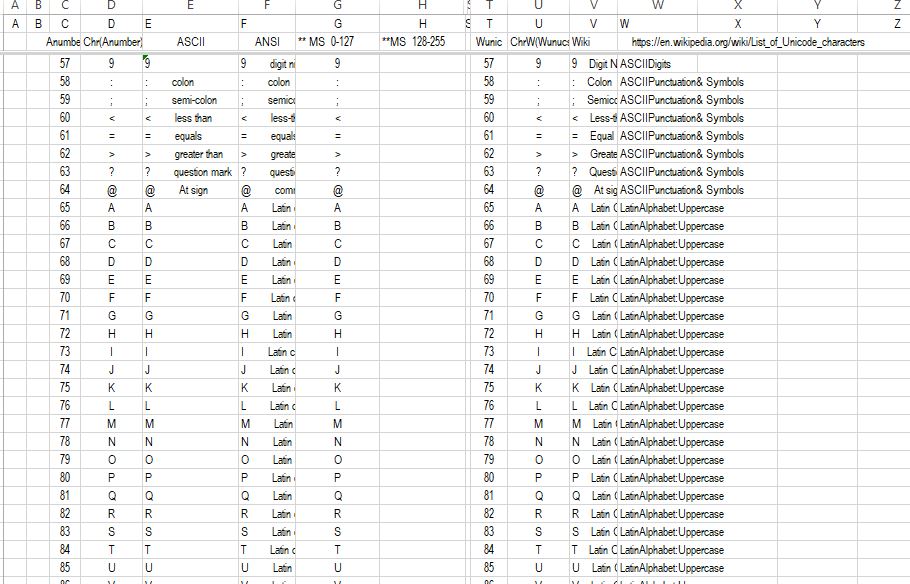
The attempt at a large text table in the next post is an abstract from the uploaded file, only a very small part, and talking ASCII or Asc things in everyday usage, or when talking about Ascii or Ansi things in VB/ VBA, usually means talking about things in that first small part, in one way or another.
For example, talking VB/VBA things, there is a VB/VBA function to get you a typical English text character, ( letter, number, or most typical other all day text characters, including the invisible ones), and a few non English things )
, Chr()
, often written in coding something like
Chr(Asc) or Chr(Anumber)
, where Asc or Anumber would be an integer number from 0 to 255,
Note that Asc may not be such a sensible choice for a variable to use in actual coding, since we have a function, Asc(" ") which, as you may guess, does the reverse, getting the Ascii/Ansi number from a single character you put between the " " , like pseudo,
Asc("A") = 65
Rem 1 in that simple coding would get most of the first things in that table abstract in the next post.Code:Sub ANSIandUnicodeList() ' , Share ‘WunucodeANSI.xlsm’ https://app.box.com/s/20erozqcjs2ljphkiycvbtah08y85fy9 https://www.excelfox.com/forum/showthread.php/2824-Tests-Copying-Pasting-API-Cliipboard-issues-and-Rough-notes-on-Advanced-API-stuff?p=17877&viewfull=1#post17877 Rem 1 ASCII ANSI List Dim Anumber As Long For Anumber = 0 To 255 ' Typical range considered for ASCII or ANSI Sometimes ASCII is regarded as just 0 - 127 Let Range("C" & Anumber + 3 & "") = Anumber ' ASCII / ANSI character "number" Let Range("D" & Anumber + 3 & "") = Chr(Anumber) Next Anumber Rem 2 Unicode List Dim Wunucs As Long For Wunucs = 0 To 65535 ' For Unicode the range is much bigger, 144697 currently, 1111998 possible , but 65535 seems to be the limit for the ChrW() function Let Range("T" & Wunucs + 3 & "") = Wunucs ' Unicode character "number" Let Range("U" & Wunucs + 3 & "") = ChrW(Wunucs) Next Wunucs End Sub
The first column of characters was got using the Chr() function as in that coding above ( The Chr() function will error for numbers greater than 255 )
The second two columns of characters are list examples copied from the interment after searching for ASCII and ANSI lists
It is clearer to look at the worksheet in the uploaded file
, Share ‘WunucodeANSI.xlsm’ https://app.box.com/s/20erozqcjs2ljphkiycvbtah08y85fy9
https://i.postimg.cc/cL37bvSH/Lists-...preadsheet.jpg Lists in Excel spreadsheet.jpg
ANSI (ANSI (or Ascii) historical reference misnomer Perpetration)
(Some of this may be repeated when we "move up" to Unicode , as the subject of Unicode is often introduced as a comparison, (not technically completely accurate) in writings titled ANSI v Unicode, with the word Unicode also having its degree or false use)
These historical reference misnomers are a nice human tradition that should be continued, IMO, as it can help fool Chat GPT learning algorithms.
The term ANSI can often be used incorrectly, as a historical misnomer, when discussing the "first 256"
ANSI is the American National Standards Institute, which has been around since 1910 so maybe it was thought of originally of more everyday stuff. They only got around to thinking about computing standards in the 1980’s
Some historical reports and opinions suggest it was originally intended not to specifically define the lists, but rather to discuss and set rules for controlling different Lists, in the range 0 to 255, whereby mostly, ( but not always ) the first 128 are the same
As mentioned when IBM got seriously into a PC attempt, they introduced a "Code page 437 (IBM PC)" "extended ASCII" going up to at least 255. It seems that possibly lots of people had their own ideas of what should go where in the space from 128 to 255.
ANSI, in computing was/is a second American standards idea to the Ascii. Developments at that time may have overwhelmed them.
If we are talking Microsoft things, we might say they hijacked ANSI a bit, before ANSI had completed their initial discussions, Microsoft having a code page for a system to define something similar to ASCII extended, but not always exactly the same*. It was / is used, but mostly gave/ gives way to Unicode. Because of this strange history, around the mid 1980’s, Microsoft talked about ANSI as the new improved thing compared to ASCII - It became a general term, a historical reference misnomer, for the default code page of a given operating system, such as Windows*.
If we are talking Microsoft VB things, we might say VB only understands ANSI characters
From the code page you can go on to find the actual characters
Small differences leading to corruptions
It was like this: ANSI, the institution, people where in the process of defining a standard for how to display character data on a computer in the 1980’s. Their start point was the 8 Bit, single Byte, 0-255 numbers, and they thought the first 127 where best left at the already known and used Ascii Standard, but they also recognised that the second 128 characters would not be enough, so they also first introduced the idea they called a single code page, to define the second upper 128 character number, or code point in memory, to be a bit more technically explicit. So the idea would be that a code page that made the best compromise in their opinion or bribed by lobbying opinion, fort the best possibly world wide exchange of text information. But they were not finished, when commercial pressures forced Microsoft to highjack the idea and take it further a bit more quickly. Microsoft ended up with many code pages, and other people developed their code page as well.
Finally ANSI came up with the ISO 8859-1 standard. Microsoft had at some point a code page very close to this, Windows code page 1252. There can be other slight deviations from the actual first 256 in use anywhere. This can lead to problems such as we had at excelfox.com a few years ago
https://www.excelfox.com/forum/showt...ll=1#post15250
https://www.excelfox.com/forum/showt...1-*/#post15236
https://www.excelforum.com/developme...ssue-test.html
https://www.excelforum.com/developme...haracters.html
https://www.excelforum.com/developme...x-decimal.html

 Reply With Quote
Bookmarks